
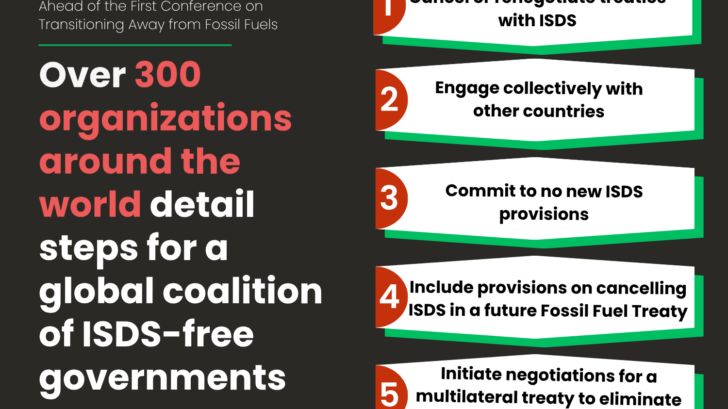
OVER 340 civil society organisations have signed an open statement calling on governments around the world to build a coalition to “free themselves” from a little-known international system of secretive tribunals. Published ahead of the First Conference on Transitioning Away from Fossil Fuels, taking place in Colombia at the end of April, the statement says this system, formally known as investor-state dispute settlement or ISDS, “threatens a just transition from fossil fuels and the urgent need for a social and ecological transformation for people and the planet.”
Cleodie Rickard, Global Justice Now, UK said :
Corporations use these secretive ISDS tribunals to sue governments outside of the national legal system over laws and policies that they fear could harm their profits. It’s a profoundly undemocratic system that undermines rights and constrains sovereignty. Fossil fuel companies have been milking ISDS for all it is worth, bullying governments into backing away from tackling dirty fuels. And when governments do go ahead, polluters use ISDS to get a payout at the taxpayer’s expense, increasing the cost of the transition.
Olivia Costa, Tanzania Trade and Investment Coalition (TATIC) said
The right to regulate natural resources and protect communities from harmful extraction must never be undermined by secretive investor–state tribunals. Awards from ISDS are huge. For developing countries, they could use such an amount to fund their budgets in the public interest—whether for climate action, public health, or social justice, instead of paying out to corporations.
Juan Camilo Sarmiento, Comité por la Defensa del Agua y Páramo de Santurbán (Committee for the Defense of Water and Páramo of Santurbán), Colombia said
ISDS is a tailor-made mechanism for transnational companies to deepen the destruction of the Earth, sustain impunity and plunder public finances. It reinforces the violence against those who stand up and defend land, nature and life. Governments have a duty to protect communities and nature, and must start moving in the same direction: away from ISDS.
Dr Patricia Ranald, Convener of the Australian Fair Trade and Investment Network said:
Governments are withdrawing from ISDS arrangements. The Australian government is excluding ISDS from new agreements and withdrawing from ISDS in existing agreements. But this is a slow process and we urge them to join with others in exploring collective government action to withdraw from ISDS arrangements
Rachmi Hertanti, Transnational Institute, Indonesia said:
Enough is enough – we have decades of experience of the harm ISDS causes and the verdict is in. It is time for governments to come together and begin building a coalition of countries committed to freeing themselves from ISDS. Countries need to commit to stop signing new agreements with ISDS, to start getting rid of existing ones and to explore collective cancellation of treaties.
Background
ISDS provisions are written into many trade and investment deals. They entitle transnational corporations to sue governments in ad hoc tribunals for taking actions they allege harm their profits. Fossil fuel companies globally are by far the biggest beneficiaries of the ISDS system, having been awarded over $87 billion in claims.
In a first for a multilateral climate forum, April’s conference prominently features on its agenda the need to address the barrier ISDS poses to a fossil-fuel phase out. This comes after Colombia’s president recently announced his intention to withdraw the country from the ISDS system.
Signatories to the open letter span over 50 countries across multiple continents plus regional and global organisations. They include 350.org, Amnesty International, Oxfam International, Friends of the Earth International, CAN Europe, CANLA, Climate Action Network Australia, SOMOS SUR (Bolivia), Black Environmental Initiative (Canada), Chile Mejor sin TLC, CAJAR (Colombia), PowerShift (Germany), The Future We Need (India), Publish What You Pay (PWYP) Indonesia, Policy Alert (Nigeria), Global Justice Now (UK) and Public Citizen (United States).